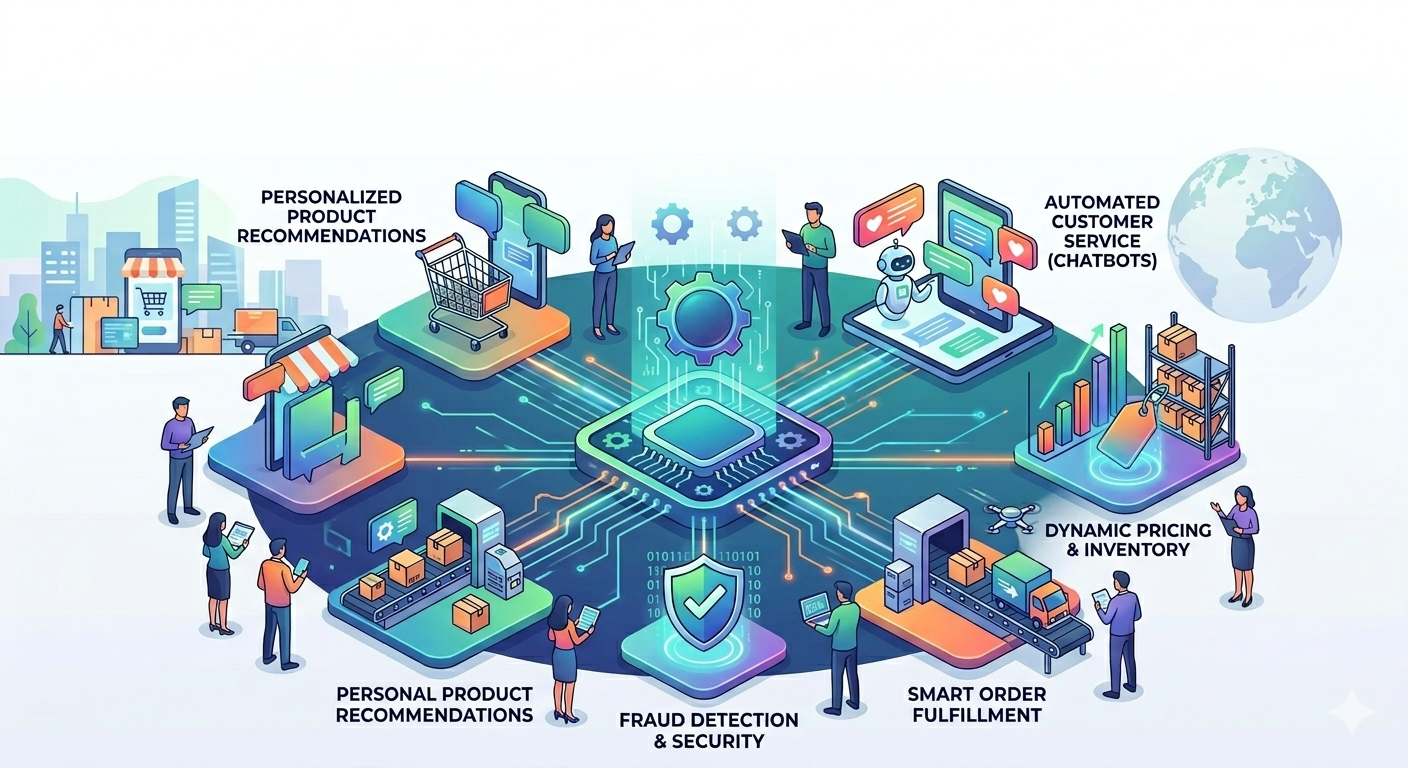
AI-Driven Product Content as the New Competitive Infrastructure
The conversation around AI in e-commerce often begins with efficiency — faster product descriptions, automated formatting, bulk catalog uploads. But this framing underestimates the scale of transformation underway.
AI-driven product content is not just about speed. It is about systemic advantage.
Modern marketplaces reward structured data, semantic depth, attribute completeness, and keyword optimization. Search engines evaluate relevance, content freshness, and user engagement signals. Customers expect clarity, transparency, and personalization.
Meeting all these demands manually is no longer sustainable.
AI systems enable brands to generate structured, SEO-optimized product descriptions at scale while maintaining taxonomy consistency across thousands of SKUs. More importantly, they integrate performance data into content workflows — turning product pages into adaptive assets rather than static entries.
CoreCom AI helps brands transition from fragmented content operations to intelligent catalog ecosystems. Instead of isolated descriptions, brands build data-rich product experiences that support discoverability, compliance, and conversion simultaneously.
Why AI Content is Now Essential — Not Optional
The urgency behind AI adoption is rooted in operational reality. Here is why:
The Scale Problem in Modern E-Commerce
E-commerce catalogs have expanded dramatically. A single marketplace seller may manage 10,000 to 50,000 SKUs across multiple platforms. Each product requires optimized descriptions, bullet points, specifications, metadata, and localization for different regions.
Manual content teams cannot keep pace with this growth without significant cost escalation.
AI-powered content generation addresses the scale problem directly. It allows brands to produce keyword-rich product descriptions instantly, maintain consistency across listings, and reduce time-to-market for new products.
CoreCom AI leverages advanced automation systems to help brands manage high-volume catalog content without compromising on quality or compliance.
The Discoverability Imperative
Search engine optimization for e-commerce is increasingly sophisticated. It requires semantic keyword mapping, structured data formatting, and contextual relevance.
AI tools can analyze high-intent keywords, integrate long-tail search queries naturally into product pages, and ensure metadata alignment across channels. This directly improves organic visibility, marketplace ranking, and click-through rates.
Without AI-driven SEO optimization, brands risk invisibility in crowded digital marketplaces.
The Omnichannel Consistency Challenge
Consumers now interact with brands across websites, marketplaces, mobile apps, and social commerce platforms. Inconsistent product information erodes trust and increases return rates.
AI ensures that product attributes, specifications, and descriptions remain standardized across channels. CoreCom AI integrates structured workflows that eliminate discrepancies and reinforce brand credibility at scale.
Key Trends Defining AI-Powered E-Commerce Content in 2026
AI adoption is not monolithic. Several emerging trends are shaping how product content evolves this year.
Hyper-Personalized Product Experiences
Generic product descriptions are losing effectiveness. Today’s consumers expect content that speaks directly to their needs.
AI systems analyze browsing behavior, customer segments, and historical purchase data to adapt product messaging dynamically. For example, a fitness tracker may emphasize calorie tracking for one user segment and sleep monitoring for another.
This level of personalization increases engagement and conversion probability.
CoreCom AI integrates intelligent segmentation into content workflows, allowing brands to scale personalization without multiplying manual effort.
SEO Automation and Semantic Optimization
Search algorithms now prioritize contextual depth over keyword stuffing. AI-powered content systems analyze related search queries, identify semantic clusters, and structure product descriptions to align with user intent.
Structured Data and Rich Snippets
AI assists in formatting schema markup and structured product attributes, improving eligibility for rich snippets and enhanced search results.
Continuous Performance Feedback
AI tools can evaluate which product headlines generate higher click-through rates and refine future outputs accordingly.
This feedback-driven optimization transforms product content into a living system rather than a static document.
Visual AI Enhancements and Content Integration
Product content in 2026 extends beyond text. AI-generated product imagery, automated background enhancement, and short-form product videos increase engagement.
Visual optimization improves dwell time and reduces uncertainty — particularly in categories like fashion, electronics, and home décor.
CoreCom AI supports integrated content ecosystems where text, attributes, and visual elements align strategically to strengthen conversion outcomes.
Multilingual Expansion and Global Commerce
Global expansion once required extensive translation teams and localized content strategies. AI-driven localization now accelerates this process dramatically.
AI can adapt tone, terminology, and cultural references to regional markets while maintaining brand voice consistency. This reduces friction in international marketplace onboarding and opens new revenue streams.
CoreCom AI enables brands to scale globally without operational chaos, ensuring multilingual product descriptions meet both linguistic and marketplace standards.
From Static Listings to Intelligent, Self-Optimizing Catalogs
Perhaps the most profound transformation lies in how product content evolves over time.
Traditional catalogs are static. They are written, published, and left unchanged unless manually updated.
AI-driven catalogs are dynamic.
Performance-Driven Content Adjustments
Future-ready systems analyze engagement metrics, bounce rates, and conversion performance to suggest content refinements. Headlines can be optimized based on click-through rates. Bullet points can be reorganized based on customer attention patterns.
Dynamic Pricing Logic and Data Validation
AI can flag pricing inconsistencies, detect anomalies, and ensure compliance with marketplace guidelines. This reduces penalties and protects brand reputation.
H3: Predictive Content Structuring
AI models can identify which product attributes correlate with higher conversion rates and prioritize those details within descriptions.
These capabilities elevate product content from a marketing asset to an operational intelligence layer.
CoreCom AI integrates structured validation and adaptive learning mechanisms that allow brands to move toward this self-optimizing future without overwhelming internal teams.
The Strategic Risk of Ignoring AI-Driven Content
The adoption gap between AI-enabled brands and manually operated competitors is widening.
Brands that fail to implement AI-driven product content strategies face:
- Slower product launch cycles
- Inconsistent catalog data
- Lower organic search visibility
- Higher operational costs
- Increased marketplace compliance risks
Meanwhile, AI-integrated brands are accelerating content production, refining SEO performance, and scaling globally with confidence.
This divergence is not temporary. It represents a structural shift in competitive dynamics.
How CoreCom AI Enables Strategic AI Deployment
Adopting AI is not about plugging in a generic content generator. It requires integration, oversight, and alignment with brand objectives.
CoreCom AI approaches AI-driven product content as a structured system rather than a standalone tool. By combining automation with expert validation and data governance frameworks, CoreCom AI ensures brands achieve both scalability and strategic precision.
Brands partnering with CoreCom AI gain:
- Intelligent catalog management
- SEO-optimized product descriptions at scale
- Compliance-ready marketplace listings
- Multilingual content workflows
- Performance-driven optimization systems
Instead of reacting to e-commerce complexity, they build infrastructure that anticipates it.
The Broader Implication for E-Commerce in 2026 and Beyond
AI-driven product content represents more than technological progress. It signals a philosophical shift.
E-commerce is no longer about listing products online. It is about constructing intelligent ecosystems where data, content, and automation collaborate to drive measurable growth.
Product pages are becoming adaptive interfaces. Catalogs are becoming analytical engines. Content teams are evolving into strategic orchestrators of AI systems.
The brands that thrive in 2026 will not treat AI as an experimental add-on. They will treat it as foundational infrastructure.
With CoreCom AI guiding this transformation, businesses do not merely adopt artificial intelligence — they deploy it with intention, structure, and competitive clarity.
In a marketplace defined by visibility, accuracy, and speed, AI-driven product content is not a trend.
It is the new architecture of digital commerce.